
What we’re reading (6/8)
“Why The Pandemic Probably Started In A Lab, In 5 Key Points” (New York Times). “[A] growing volume of evidence — gleaned from public records released under the Freedom of Information Act, digital sleuthing through online databases, scientific papers analyzing the virus and its spread, and leaks from within the U.S. government — suggests that the pandemic most likely occurred because a virus escaped from a research lab in Wuhan, China. If so, it would be the most costly accident in the history of science.”
“The Unexpected Origins Of A Modern Finance Tool” (MIT News). “Discounting calculations are ubiquitous today — thanks partly to the English clergy who spread them amid turmoil in the 1600s, an MIT scholar shows.”
“Beneath The Calm Market, Stocks Are Going Haywire” (Wall Street Journal). “It is easy to look at the piddling daily moves in the S&P 500 and think the market has been oh-so-boring recently. There hasn’t been a 2% move since February and the VIX gauge of expected volatility is only up a bit from the postpandemic low reached last month. Under the calm surface, however, there is furious paddling. Only once in the past 25 years have stocks swung about like this while the overall market stayed so placid. Traders in the options markets are betting on its continuing: Prices indicate the biggest swings in stocks for at least 10 years relative to the prevailing calm for the S&P 500.”
“Zombies: Ranks Of World’s Most Debt-Hobbled Companies Are Soaring, And Not All Will Survive” (Associated Press). “They are called zombies, companies so laden with debt that they are just stumbling by on the brink of survival, barely able to pay even the interest on their loans and often just a bad business hit away from dying off for good. An Associated Press analysis found their numbers have soared to nearly 7,000 publicly traded companies around the world — 2,000 in the United States alone — whiplashed by years of piling up cheap debt followed by stubborn inflation that has pushed borrowing costs to decade highs. And now many of these mostly small and mid-sized walking wounded could soon be facing their day of reckoning, with due dates looming on hundreds of billions of dollars of loans they may not be able to pay back.”
“Celebrating The Glamorous Heyday Of The Department Store” (Washington Post). “Convinced that top-notch service was key to their success, department stores offered their employees handsome salaries and often provided their staff with in-house health care and even resorts. They could take free courses in interior design and merchandising at New York University. The stores were, Satow posits in several compelling ways, a way for women to get ahead when few professional avenues were available to them.”
What we’re reading (6/7)
“Keith Gill’s Riotous Return To YouTube Had Beer, Charts And A GameStop Pep Talk” (Wall Street Journal). “Keith Gill’s livestream Friday had many of the same ingredients as the 2021 videos that made him a legend to scores of everyday investors eager to strike it big in the stock market. He donned sunglasses. He spoke from his signature red gaming chair. He poured a beer, cracked jokes and cheered on the Celtics. He even had a few props, including his Magic 8 Ball. ‘It’s five o’clock somewhere,’ Gill said. The crowd loved it.”
“Roaring Kitty Rambled About Memes, Guzzled A Beer, And Revealed His E-Trade Account In A Long-Awaited Livestream. It Couldn’t Reverse A 41% Decline In The Stock.” (Business Insider). “Gill also revealed his portfolio, which was worth $350 million as of 1 p.m. ET on Friday. Apart from talking about GameStop, Gill confirmed that he's behind all of his social-media accounts and that he did not sell any, as some on the internet had speculated. Gill told viewers that only his money was behind his $350 million position in GameStop and that he's not working with anyone else.”
“‘Everything Is Not Going to Be OK’ In Private Equity, Apollo’s Co-President Says” (Bloomberg). “‘I’m here to tell you everything is not going to be ok,’ the Apollo co-president said in a session at the SuperReturn International conference in Berlin on Wednesday. ‘The types of PE returns it enjoyed for many years, you know, up to 2022, you’re not going to see that until the pig moves through the python. And that is just the reality of where we are.’ Private equity firms didn’t take significant markdowns during the recent period of rapid rate hikes which means that ‘investors of all sorts are going to have swallow the lump moving through the system,’ he said, referring to assets that private equity firms bought up until 2022. Funds are now holding on to these companies and will eventually have to refinance at higher rates.”
“The Slow Death Of A Fabled Media Empire” (New York Times). “Because Paramount Global’s ownership structure gives all power to its largest voting shareholder, the company’s future comes down to the whims of just one person: the 70-year-old heiress Shari Redstone. She chose to put Paramount on the block, and she alone is deciding between a buyer whose strategy could very well further weaken, or kill, these cultural icons — and one that at least allows for some hope of a creative revival. She could, of course, reject both options, and try to maintain what’s left of the status quo. Is this how we want our cultural future to be decided?”
“Procyclical Stocks Earn Higher Returns” (William Goetzmann, Akiko Watanabe, and Masahiro Watanabe). “We find that procyclical stocks, whose returns comove with business cycles, earn higher average returns than countercyclical stocks. We use almost a three-quarter century of real GDP growth expectations from economists’ surveys to determine forecasted economic states. This approach largely avoids the confounding effects of econometric forecasting model error. The loading on the expected real GDP growth rate is a priced risk measure. A fully tradable, ex-ante portfolio formed on this loading generates a procyclicality premium that is statistically significant, economically large, long-lasting over a few years, and independent of the size, book-to-market, and momentum effects.”
What we’re reading (6/3)
“NYSE Says Technical Issue That Caused Berkshire Hathaway To Be Displayed Down 99% Is Fixed” (CNBC). “A technical issue on Monday caused the A-class shares of Warren Buffett’s Berkshire Hathaway to appear to be down nearly 100% on the New York Stock Exchange for most of the morning trading period. Trading was halted in those shares, as well as in Barrick Gold and Nuscale Power, which had also seen dramatic falls. All three stocks have since resumed trading.”
“‘Roaring Kitty’ Post Seems To Show Trader Held Onto Giant GameStop Stake After Monday’s Rally” (CNBC). “Gill, whose handle is ‘DeepF------Value’ on Reddit and ‘Roaring Kitty’ on YouTube and X, posted another screenshot of his portfolio showing the same common stock and call option holdings Monday after the stock market closed as those he shared Sunday evening. He still owned 5 million shares of GameStop and 120,000 call options with a strike price of $20 that expire on June 21, the screenshot showed. The post on Reddit’s r/SuperStonk forum could not be independently verified by CNBC. “
“E*Trade Considers Kicking Meme-Stock Leader Keith Gill Off Platform” (Wall Street Journal). “Shortly before Gill reignited a meme-stock craze in May, he bought a large volume of GameStop options on E*Trade, the people said. This week, Gill posted screenshots of an E*Trade account showing he owns GameStop shares now valued at $140 million and a new set of options that expire later this month. His total gains on the positions were at $85.5 million, he posted late Monday, showing his account remained in operation. The stock of GameStop surged again on his posts, showing the power Gill, also known as Roaring Kitty and DeepF—Value, has as an influencer. GameStop shares, up 21% on Monday, have risen more than 60% since he reappeared.”
“Oil And Gas Companies Are Trying to Rig The Marketplace” (New York Times). “[Y]ou might reasonably conclude that the market is pivoting, and the end for fossil fuels is near. But it’s not. Instead, fossil fuel interests — including think tanks, trade associations and dark money groups — are often preventing the market from shifting to the lowest cost energy.”
“Wealth Inequality In A Low Rate Environment” (Matthieu Gomez, Econometrica). “We study the effect of interest rates on wealth inequality. While lower rates decrease the growth rate of rentiers, they also increase the growth rate of entrepreneurs by making it cheaper to raise capital. To understand which effect dominates, we derive a sufficient statistic for the effect of interest rates on the Pareto exponent of the wealth distribution: it depends on the lifetime equity and debt issuance rate of individuals in the right tail of the wealth distribution. We estimate this sufficient statistic using new data on the trajectory of top fortunes in the U.S. Overall, we find that the secular decline in interest rates (or more generally of required rates of returns) can account for about 40% of the rise in Pareto inequality; that is, the degree to which the super rich pulled ahead relative to the rich.”
May performance update
Here with a May performance update:
Prime: +1.33%
Select: +3.38%
SPY ETF: +5.18%
Bogleheads portfolio (80% VTI, 20% BND): 4.15%
A fine month overall for the Stoney Point strategies, and one that historically would be considered quite strong. But the market overall continues to perform even better, with an extraordinarily good month. Qualitatively, AI hopes appear to continue to power the S&P higher. I posted an article a few days ago highlighting that four companies now represent nearly 40% of the S&P index. Unsurprisingly, these are all AI giants. Time will tell whether the commercial opportunity for that will live up to the hype, but so far it seems to be a good bet.
Stoney Point Total Performance History
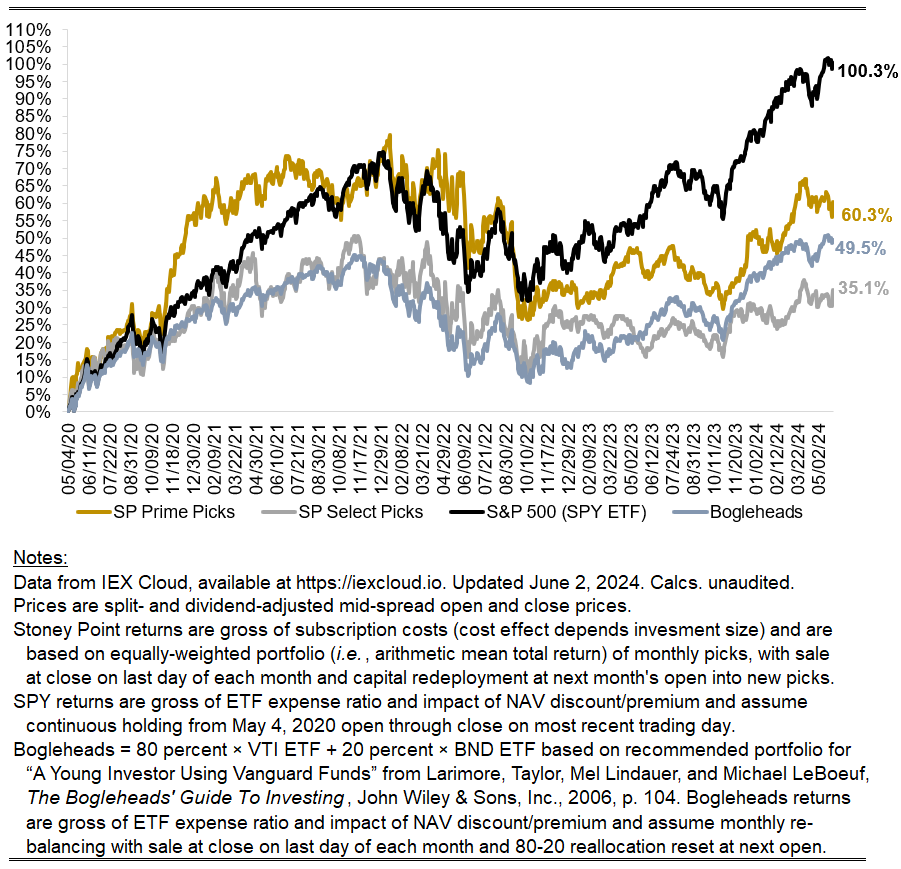
June picks available now
The new Prime and Select picks for June are available starting now, based on a model run put through Today (May 31). As a note, I will be measuring the performance on these picks from the first trading day of the month, Monday, June 3, 2024 (at the mid-spread open price) through the last trading day of the month, Friday, June 28, 2024 (at the mid-spread closing price).
What we’re reading (5/30)
“This Record Stock Market Is Riding On Questionable AI Assumptions” (Wall Street Journal). “Nvidia’s profits are rising about as fast as its share price, so if there is a bubble, it’s a bubble in demand for chips, not a pure stock bubble. To the extent there is a mispricing, it’s more like the banks in 2007—when profits were unsustainably high—than it is to the profitless dot-coms of the 2000 bubble. The threat to Nvidia’s share price is therefore about threats to its earnings. There are four risks: 1) Demand falls because AI is overhyped […] 2) Competition reduces prices […] 3) Nvidia’s biggest supplier, Taiwan Semiconductor Manufacturing, might want a bigger slice […] 4) What if scale doesn’t matter?”
“Lazy Work, Good Work” (Collab Fund). “John D. Rockefeller was the most successful businessman of all time. He was also a recluse, spending most of his time by himself. He rarely spoke, deliberately making himself inaccessible and staying quiet when you caught his attention.”
“Yes, Walmart Store Managers Really Can Make $500,000 A Year” (Bloomberg). “The world’s largest retailer is rethinking one of its most important roles after falling behind the competition. A couple of years ago, Walmart’s attrition rate for store managers spiked to almost double that of other big-box retailers such as Home Depot Inc. and Target Corp., according to data from human resources analytics company Revelio Labs Inc. Departures first ticked up when Walmart cut management ranks in the late 2010s, saddling those who remained with more work and longer hours, according to two former managers who declined to be named. At the time, the company was more focused on improving conditions for its hourly workers, investing billions in upgrading their wages.”
“You Can Thank Private Equity For That Enormous Doctor’s Bill” (Wall Street Journal). “Years of dealmaking has led to sprawling hospital systems, vertically integrated health insurance companies, and highly concentrated private equity-owned practices resulting in diminished competition and even the closure of vital health facilities. As this three-part Heard on the Street series will show, the rich rewards and lax oversight ultimately create pain for both patients and the doctors who treat them.”
“Home Insurance Was Once A ‘Must.’ Now More Homeowners Are Going Without.” (Washington Post). “Most uninsured homeowners are those who have paid off their mortgage and are no longer required to have insurance. Among those who own their home outright, the CFA estimates roughly 14 percent are uninsured, with low-income and minority homeowners especially at risk. Among mortgage holders, only 2 percent opt to go without coverage. Experts say this trend is driven by the escalating threat of climate change — which has forced insurers to make larger and larger payouts — and skyrocketing housing prices. Both trends are pushing the cost of policies up. On average, home insurance policies rose 11.3 percent in 2023, according to S&P Global.”
June picks available soon
I’ll be publishing the Prime and Select picks for the month of June before Monday, June 3 (the first trading day of the month). As always, SPC’s performance measurement for the month of May, as well as SPC’s cumulative performance, will assume the sale of the May picks at the closing price (at the mid-point of the closing bid and ask prices) on the last trading day of the month (Friday, May 31). Performance tracking for the month of June will assume the June picks are bought at the open price (at the mid-point of the opening bid and ask prices) on the first trading day of the month (Monday, June 3).
What we’re reading (5/26)
“How An Ex-Teacher Turned A Tiny Pension Into A Giant-Killer” (Wall Street Journal). “Plymouth County is known for Pilgrims, cranberries—and a top-performing pension fund run by a 65-year-old former schoolteacher. After a decade of mostly ho-hum performance, the $1.4 billion Plymouth County Retirement Association ranked in the top 10% of U.S. pensions over the past three years. Key to that success was an early—and prescient—bet that interest rates would rise. That buoyed the fund through big chunks of the past two years, when climbing rates hammered both stocks and bonds.”
“Tesla Shareholders Advised To Reject Musk’s $56 Billion Pay” (CNBC). “Proxy advisory firm Glass Lewis said on Saturday it has urged Tesla shareholders to reject a $56 billion pay package for Chief Executive Officer Elon Musk, which if passed would be the largest pay package for a CEO in corporate America.”
“What Do Students At Elite Colleges Really Want?” (New York Times). “Over the last five years or so, ‘the idea of thinking about your professional path has moved much earlier in the undergraduate experience,’ Ms. Ciesil said. She said the banks first began talking to students earlier, and it was the entrance of Big Tech onto the scene, asking for junior summer applications by the end of sophomore year, that accelerated recruitment timelines. ‘At first, we tried to fight back by saying, ‘No, no, no, no, no, sophomores aren’t ready, and what does a sophomore know about financial modeling?’’ said Mr. Woolsey at Union College. But, he added, schools ‘don’t want to push back too much, because then you’re going to lose revenue,’ since firms often pay to recruit on campus.”
“How To Build 300,000 Airplanes In Five Years” (Construction Physics). “One of the most important elements in the ‘Arsenal of Democracy’ [during WWII] was aircraft. Over the course of the war the U.S. produced around 325,000 airplanes valued at roughly $46 billion ($800 billion in 2024 dollars). Not only is this more aircraft than what Germany, Japan, and Italy combined produced during the war — it’s also more aircraft than have been built for commercial transport in the entire history of aviation.”
“The Chuck E. Cheese Band Delays Retirement With An Encore At 3 More Stores” (Washington Post). “More of Chuck E. Cheese’s animatronics bands are here to stay at five locations as the pizza-and-arcade chain tries to lean into fans’ nostalgia while endearing Chuck to today’s children. The brand announced last year that it would retire its Munch’s Make-Believe Bands except one ‘permanent residency’ in Northridge, Calif., which the company says has become a destination for wistful parents. In addition to the full-stage band in Northridge — and a previously announced solo-Chuck set at a ‘100% retro store’ in Nanuet, N.Y. — bands will remain in Springfield, Ill., Hicksville, N.Y., and Charlotte, N.C. Everywhere else, though, will shed the once-ubiquitous American icons in a matter of months.”
What we’re reading (5/25)
“Q1 2024 Household Debt And Credit: Rising Delinquency Rates Raising Concerns” (Regions). “The overall delinquency rate on household debt rose to 3.25 percent in Q1 from 3.13 percent in Q4 2023, with a particularly large increase in severely derogatory accounts, i.e., those accounts in some stage of delinquency on which there has been either a report of repossession, a charge-off to bad debt, or a foreclosure action. Though having moved higher over recent quarters, early-stage and overall delinquency rates remain below pre-pandemic norms.”
“Inside The Rockefeller Clan’s Intensifying Feud With Exxon” (Wall Street Journal). “The Rockefeller Family Fund, the charity she [Rockefeller heir Miranda Kaiser] is president of, is funding litigation and other support for more than 30 lawsuits around the U.S. against the fossil fuel industry. Exxon is a defendant in all of them. Fund staffers also consult with state attorneys general, nine of whom have brought cases against Exxon. The cases aim to collect billions of dollars from Exxon and its peers for their contributions to climate change and the damages caused by it.”
“How A Global Seafood Giant Broke Red Lobster” (CNN Business). “Thai Union’s damaging decisions drove the pioneering chain’s fall, according to 13 former Red Lobster executives and senior leaders in various areas of the business as well as analysts. All but two of the former Red Lobster employees spoke to CNN under the condition of anonymity because of either non-disclosure agreements with Thai Union; fear that speaking out would harm their careers; or because they don’t want to jeopardize deferred compensation from Red Lobster.”
“Instagram’s Desperate Move” (Business Insider). “Ultimately, the Instagram badges aren't the end of the world. At best, they're a nothingburger. At worst, they seem a bit lame and add to the vibe that Instagram is becoming a platform for olds.”
“Meta Walked Away From News. Now The Company’s Using It For AI Content.” (Washington Post). “After years of Meta steadily walking away from news on its platforms, the company’s new AI tool is now using the work of those outlets for content.”
What we’re reading (5/24)
“What Our Brains Know About Stocks—But Won’t Tell Us” (Wall Street Journal). “In the past few years, researchers have been investigating “neuroforecasting.” That’s the apparent ability of activity in the brain to forecast outcomes—even when people are unaware of it. Neuroscientists have asked participants to predict which requests for microlending will raise the most money online, which ventures will receive the most crowdfunding, how popular video clips or songs will be, or whether a stock would go up or down. Consistently, people’s conscious choices when confronted with these sorts of questions aren’t significantly better than chance. But the intensity of activation in their nucleus accumbens, an area of the brain that subconsciously processes anticipation of reward, turns out to be a good predictor of what people will collectively decide they like.”
“A Lender To Consumer Start-Ups Falters, Rattling Its Clients” (New York Times). “A popular lender backed by venture capital firms is struggling financially, sending shock waves through the small clothing and home furnishing companies that count on its financing. The lender, Ampla, spent years courting small direct-to-consumer brands with low rates and a pitch that it understood their needs. In recent weeks, its top executives have been searching for a buyer, two people familiar with the firm’s finances said. Last week, Ampla, which is based in New York, said it would lay off half its 62 workers.”
“America Is Still Having A ‘Vibecession’” (Paul Krugman, New York Times). “The gold standard for assessing economic perceptions is the Federal Reserve’s annual survey of economic well-being of American households. The results of the latest survey, taken in October, have just been released, and while there’s a lot of information in the report — notably, families with children appear to have been hit hard by the end of pandemic-era financial aid — the key finding hasn’t changed much. Most Americans continue to say that they’re doing OK financially, but they think the national economy is doing badly — while they’re being considerably more positive about their local economy. Wasn’t it always thus? No. As the report notes, ‘the gap between people’s perceptions of their own financial well-being and their perception of the national economy has nearly doubled since 2019.’”
“The Rise And Fall Of Simon Sadler's Segantii, One Of Asia's Most Successful Hedge Funds” (Bloomberg). “The legal heat became too much for Simon Sadler. The founder of Segantii Capital Management has told investors that it’s winding down and returning their money, marking the end of a 16-year run for one of the largest and most successful hedge funds[.]”
“Welcome To The WFH Friday Economy: It’s A Time For Hair Masks, Spas, Day Drinking, And No-Camera Meetings” (Business Insider). “Friday was the most popular day for spa and salon appointments booked on ClassPass in 2023, according to data the company provided to BI. The top time for fitness classes on Fridays in 2023 was 12 p.m. — perhaps indicating a rush of lunchtime exercisers. The top time to hit the salon or spa was 5 p.m. on the dot. Upticks in foot traffic at Starbucks, Sweetgreen, and Panera Bread shown by Placer.ai could suggest people are more frequently treating themselves to lunch or coffee out, working at coffee shops, or signing off earlier from work on Fridays. Indeed, an ActivTrak analysis of 75,000 workers found that whether or not they were going into the office on Friday, they were signing off at about 4 p.m. that day, compared with 5 p.m. on Mondays through Thursdays.”
What we’re reading (5/23)
“Stocks Slide, Dow Suffers Worst Day In A Year As Nvidia Fails To Spur Market Rally” (Yahoo! Finance). “Stocks slid from record levels on Thursday as interest rate worries dominated investor sentiment after Nvidia's (NVDA) blockbuster earnings failed to spur a broader market rally.”
“FTC Chair: AI Models Could Violate Antitrust Laws” (The Hill). “‘The FTC Act prohibits unfair methods of competition and unfair or deceptive acts or practices,’ Khan said at the event. ‘So, you can imagine, if somebody’s content or information is being scraped that they have produced, and then is being used in ways to compete with them and to dislodge them from the market and divert businesses, in some cases, that could be an unfair method of competition.’”
“Top PE Funds See Mediocre Returns As Exits Slow” (Institutional Investor). “For funds between seven and nine years old, ‘half of the stated asset value consists of unsold deals that are ‘marked to market’ by the private equity managers,’ according to a study by Jeffrey Hooke, a senior finance lecturer at Johns Hopkins Carey Business School who focuses on the alternative asset class.”
“Redefining The Scientific Method: As The Use Of Sophisticated Scientific Methods That Extend Our Mind” (PNAS Nexus). “Scientific, medical, and technological knowledge has transformed our world, but we still poorly understand the nature of scientific methodology. Science textbooks, science dictionaries, and science institutions often state that scientists follow, and should follow, the universal scientific method of testing hypotheses using observation and experimentation. Yet, scientific methodology has not been systematically analyzed using large-scale data and scientific methods themselves as it is viewed as not easily amenable to scientific study. Using data on all major discoveries across science including all Nobel Prize and major non-Nobel Prize discoveries, we can address the question of the extent to which ‘the scientific method’ is actually applied in making science's groundbreaking research and whether we need to expand this central concept of science. This study reveals that 25% of all discoveries since 1900 did not apply the common scientific method (all three features)[.]”
“Should Governments Crack Down On Fake Job Postings?” (Dealbreaker). “While the details vary, ghost jobs fall into one of two categories. The first are advertised job openings although employers have no intention of actually hiring anyone. Companies do this to project an image that they are growing, to placate overworked employees, gauge salary demands in order to determine whether to give existing employees raises, or to have a list of people who may be available in the future. The second type of ghost jobs are those that have requirements that are so strict and specific that only a few people will be eligible. Usually this is the case where the company has already selected who they want to hire internally but is required to make the job opening public due to legal requirements (although this requirement only seems to apply for federal contracting jobs) or contractual requirements such as a collective bargaining agreement. These job postings are also suspected to automatically reject unemployed candidates and instead target people who are already employed and want to leave their current job.”
What we’re reading (5/22)
“Fed Officials Saw Longer Wait For Rate Cuts After Inflation Setbacks” (Wall Street Journal). “Federal Reserve officials concluded at their most recent meeting they would need to hold interest rates at their current level for longer than they previously anticipated after a third straight disappointing inflation reading last month.”
“The Second Great Bailout” (The Grumpy Economist). “After 2008, politicians and regulators promised the Dodd-Frank Act would stop bailouts. They failed. We document the massive bailouts of 2020-2023. But this time nobody is even promising to do anything about it. Too big to fail has spread everywhere. The basic architecture of allowing highly leveraged finance but promise that regulators will stop risks has failed. We have now tried everything else, it’s time for equity-financed banking and narrow deposit taking.”
“Tracing OpenAI CEO Sam Altman’s Love for Scarlett Johansson’s AI Romance Her” (Vanity Fair). “In September 2003, OpenAI cofounder and CEO Sam Altman was asked to name his favorite movie about artificial intelligence. It was two months before Altman would be pushed out of his company because, according to his board of directors, Altman was ‘not consistently candid in his communications’ with the board….onstage at Dreamforce 2023 in San Francisco, with a fake waterfall backdrop frozen behind him, Altman said that Spike Jonze’s 2013 film Her resonated with him more than other sci-fi films about AI.”
“This Man Did Not Invent Bitcoin” (New York Times). “The mystery of Satoshi’s identity has long obsessed crypto experts, who analyze every record of his communications with the reverence of Talmudic scholars. Various candidates have been proposed as possible Satoshis, only for them to deny any role in Bitcoin’s creation. Dr. Wright, by contrast, has gone to extraordinary lengths to prove that he is Satoshi. He has presented himself as Bitcoin’s inventor in interviews and social media posts, laying out evidence for virtually anyone who would listen. In lawsuits tried in three countries, he has testified that he wrote the original white paper. After a small-time crypto personality challenged his claims in 2019, Dr. Wright sued for defamation in England. He followed that up with an aggressive suit against software developers working to improve Bitcoin’s code, accusing them of violating his intellectual property rights.”
“100-Hour Weeks And Heart Palpitations: Inside Wall Street’s Brutal Work Culture” (New York Post). “The tragic death of former Green Beret and Bank of America employee Leo Lukenas III has become a flashpoint of anger over allegedly unrealistic work expectations on Wall Street — partly because some bankers say Lukenas’ experience is so similar to their own. While there is no evidence that job-related stress caused the blood clot that killed 35-year-old Lukenas on May 2, a recent Reuters report that he was talking with a recruiter to find a job with better hours has put a glaring spotlight on the 100-hour work weeks he was said to be juggling before his death.”
What we’re reading (5/21)
“Red Lobster Superfans Desperately Want A Piece Of The Bankrupt Chain” (Business Insider). “At the time the auctions closed, TAGeX's website showed that the entire contents of each location sold for between $10,000 and $35,000. That included everything from upright refrigerators and microwaves to fish tanks, furniture, and, in some cases, decor.”
“The High-Class Problem That Comes With Home Equity” (New York Times). “[R]everse mortgages or something like them seem inevitable in a nation where individuals are entirely responsible for their own retirement savings.”
“The Growing Importance Of Desalination” (Contrary). “[M]odern desalination plants are capable of converting roughly 80% of the saline water piped into potable water. The remainder is so heavily concentrated with salt that filtering it even further would be economically inefficient. This remainder is called brine and needs to be disposed of appropriately. An additional consideration for modern plants is that the filtration membranes need to be maintained and cleaned periodically as molecular compounds and minerals can get stuck in the membrane, decreasing its efficiency.”
“East Coast Has A Giant Offshore Freshwater Aquifer—How Did It Get There?” (ars technica). “For decades, scientists have known about an aquifer off the US East Coast. It stretches from Martha’s Vineyard to New Jersey and holds almost as much water as two Lake Ontarios. Research presented at the American Geophysical Union conference in December attempted to explain where the water came from—a key step in finding out where other undersea aquifers lie hidden around the world.”
“Private Equity Is No Place For Your Nest Egg” (Bloomberg). “Retirement is expensive. If you’re lucky, yours will last a few decades, and you’ll be earning no or very little income. So if you want to have enough money when you retire, you basically have three options: Save more, take more risk with your investments, or work longer. Many people find the first and third options undesirable or impossible. That leaves the second option. And despite what people such as Marc Rowan might lead you to believe, there’s really no way to get a higher return without taking more risk.”
What we’re reading (5/20)
“What Does The Dow Hitting 40,000 Tell Us?” (Paul Krugman, New York Times). “Unlike many right-wing commentators, I don’t consider the stock market the best indicator of the economy’s health, or even a good indicator. But it is an indicator. And given the state of American politics, with hyperpartisanship and conspiracy theorizing running rampant, I’d argue that this market milestone deserves more attention than it has been getting.”
“ChatGPT Can Talk, But OpenAI Employees Sure Can’t” (Vox). “what has really stirred speculation was the radio silence from former employees. [Ilya] Sutskever posted a pretty typical resignation message, saying ‘I’m confident that OpenAI will build AGI that is both safe and beneficial…I am excited for what comes next.’ [Jan] Leike ... didn’t. His resignation message was simply: ‘I resigned.’ After several days of fervent speculation, he expanded on this on Friday morning, explaining that he was worried OpenAI had shifted away from a safety-focused culture.”
“Press Pause On The Silicon Valley Hype Machine” (New York Times). “It’s a little hard to believe that just over a year ago, a group of leading researchers asked for a six-month pause in the development of larger systems of artificial intelligence, fearing that the systems would become too powerful. ‘Should we risk loss of control of our civilization?’ they asked. There was no pause. But now, a year later, the question isn’t really whether A.I. is too smart and will take over the world. It’s whether A.I. is too stupid and unreliable to be useful.”
“Oracle’s Deadly Gamble” (Business Insider). “Cerner was a total mess. While Ellison was fixated on the wildly exciting possibilities of marrying Cerner's medical records with Oracle's technology, Cerner was failing at even the most elementary tasks of data management. The company's rollout at the VA, which serves 9 million vets, had been a slow-moving catastrophe. One feature of its electronic records system had caused more than 11,000 orders for medical care to disappear into an ‘unknown queue.’ As a result, thousands of patients didn't receive the treatment their doctors had ordered. VA staffers were left in what one hospital leader called ‘a constant state of hypervigilance and distress’ as they scrambled to retrieve and reenter the missing orders, which wound up harming 149 patients. Even worse, errors in the system's underlying design were contributing factors in three deaths.”
“Ivan Boesky, Convicted In 1980s Insider-Trading Scandals, Dies At 87” (Wall Street Journal). “Ivan Boesky, who went to prison and paid a record $100 million fine for a sprawling insider-trading scandal, becoming a symbol of extravagance and corruption on Wall Street, has died at the age of 87…Boesky’s 1986 guilty plea and his cooperation with federal authorities led to the collapse of Michael Milken’s junk-bond empire and the end of the frenzied debt-fueled takeovers of the era that upended many industries. Boesky’s dramatic rise and fall marked a decade that became synonymous with unbridled ambition and even greed.”
What we’re reading (5/20)
“Sports Grow From Private Equity Afterthought To Booming Market” (Sportico). “Most every major league—and that soon will likely include the NFL—allows private equity (PE) funds to own stakes in their teams, to the point institutional investors are almost ubiquitous: At least a dozen teams in the NBA, NHL, MLB and MLS have private equity among its ownership groups. The top European soccer leagues and Formula One, as well as growing leagues from women’s soccer to lacrosse to mixed martial arts, have heavy institutional ownership.”
“Microsoft Set To Unveil Its Vision For AI PCs At Build Developer Conference” (CNBC). “One area where Microsoft has a distinct advantage over others in the AI race is in its ownership of Windows, which gives the company a massive PC userbase. Microsoft CEO Satya Nadella said in January that 2024 will mark the year when AI will become the ‘first-class part of every PC.’ The company already offers its Copilot chatbot assistant in the Bing search engine and, for a fee, in Office productivity software. Now, PC users will get to hear more about how AI will be embedded in Windows and what they can do with it on new AI PCs.”
“Our Man In East Setauket” (Institutional Investor). “The first half hour of the drive confirmed [Jim] Simons’ now famous chain-smoking habit, but otherwise it was a bit awkward. I made the mistake of telling him the names of former scientists who I knew worked at the firm. He flipped out a bit about revealing the identities of his staff in the article, and I thought he might have his driver turn the car around. Eventually, I agreed to use some but not all names.”
“Americans Are Down On The Economy (Again), With Inflation Topping Election Concerns” (The Washington Post). “Consumer sentiment, a gauge of Americans’ economic perceptions, is at a six-month low, according to a closely watched index by the University of Michigan. The measure notched its biggest drop since 2021, reflecting the persistent tug of inflation on household budgets and fueling fears that rising prices, unemployment and interest rates could all worsen in the coming months.”
“Mystery Of Mona Lisa’s Background May Have Been Solved” (The Art Newspaper). “A US geologist says she has cracked one of art history’s biggest mysteries—the location in which Leonardo da Vinci’s Mona Lisa is set. Ann Pizzorusso, who says online that she has worked in ‘oil drilling and gem hunting’, believes that the hazy landscape behind the celebrated enigmatic sitter draws on the northern Italian city of Lecco.”
What we’re reading (5/18)
“Market Froth Is Getting Extreme. Just Look At Meme Stocks.” (Wall Street Journal). “The rise of meme stocks in early 2021 came amid stock-market froth, with bubbles in SPACs, cannabis stocks, lossmaking tech, and solar and wind-related companies. They shared a common driver: Too much money in the economy had to go somewhere, and it went into stocks. Easy money was the driver of many past bubbles, too, and might again be propping up the stock market.”
“The Winners And Losers Of Meme Stock Mania Redux” (Institutional Investor). “A single post on X by Roaring Kitty sent GameStop shares soaring this week, and before the mania began to subside, short sellers were down more than $2 billion in the name — a move that fueled short squeezes in meme stocks and likely boosted a handful of hedge funds that were long both GameStop and AMC Entertainment.”
“The Fitness Fad Graveyard” (Business Insider). “he connected-fitness company is struggling. Its CEO, who joined the company in February 2022, is already stepping down. It recently announced plans to lay off 400 people, which is about 15% of its workforce. Private-equity sharks are reportedly circling. The stock is near record lows. Peloton isn't going under imminently, but let's be real here: No fitness fad lasts forever. At least culturally, the Peloton graveyard is probably on the horizon, right next to the Tae Bo cemetery and ThighMaster crematorium.”
“Watchdog Readies Crackdown On Predatory Lending After Supreme Court Win” (Washington Post). “The Consumer Financial Protection Bureau plans to restart its aggressive crackdown against payday lenders and other companies that offer high-cost, short-term loans to poor borrowers, after a Supreme Court ruling this week resolved a challenge to the federal agency’s authority to act.”
“A Would-Be Assassin Stirs Europe’s Violent Ghosts” (New York Times). “Europe is increasingly divided, and dangerously so. As in Slovakia, that divide pits nationalists opposed to immigration against liberals who see in the far right a threat to the rule of law, a free press and democracy itself. In this political world, there are no longer opponents, there are only enemies. All means are good to attack them, up to and, recent events indicate, including violence.”
What we’re reading (5/17)
“Dow Closes At Record High Above 40,000 To Cinch A Five-Week Winning Streak” (CNBC). “Stocks finished the week strong, with the Dow up 1.2% to notch its fifth straight weekly gain. The S&P 500 and Nasdaq climbed 1.5% and 2.1% week to date, cinching their longest winning streak since February.”
“The Executive Who Revived Barbie Has A New Long-Shot Mission: Save Gap” (Wall Street Journal). “The 56-year-old Dickson is the latest in a long line of Gap leaders attempting to find an answer. He is trying to reconnect with people who remember the flagship Gap brand from its heyday in the 1990s as well as younger shoppers who have no recollection that a white Gap T-shirt and pair of khakis once defined a generation.”
“The Blue-Collar Job Boom” (Business Insider). “Alyssa DeOliveira followed a well-worn path: go to college, get a degree, find a white-collar job…she tried nursing and accounting before settling on criminal justice, landing a job at a law firm. For a little over a year she arrived every morning at about 8. She listened to voicemails and checked emails. If she was lucky, she left at 5…Today, should you find yourself in Boston riding the T's green line, DeOliveira might be your conductor….She loves her job. And benefits-wise, her job loves her. ‘I'm making almost double what I was making at the office job,’ she said. ‘My office job didn't give me a 401(k), but with the T, I have the pension, I have healthcare.’”
“Current And Former Dodgers Owners, World's Wealthiest Law Firm Working On Bid To Buy TikTok” (DealBreaker). “ByteDance certainly doesn’t *want* to sell the wildly popular app TikTok. However, the United States actually got over its partisan dysfunction to pass a “divest or ban” law, so they might not have much of a choice. That is, if the legal challenges fail. Frank McCourt (the billionaire former Los Angles Dodgers owner, not the Angela’s Ashes author) is working on a bid to buy Gen Z’s social media of choice. In an announcement, McCourt revealed that he’s working in consultation with Guggenheim Securities (whose parent company's CEO currently owns the Dodgers) and Kirkland & Ellis to put together “a people’s bid’ for TikTok.”
“A Supreme Court Victory Won’t End A War On Regulators” (DealBook). “The Supreme Court lifted the existential threat hanging over the Consumer Financial Protection Bureau, rejecting a challenge to the agency’s funding. The decision could have huge consequences for a raft of conservative-led lawsuits involving administrative authority — but business groups and Republicans are vowing to fight on. A recap: Payday lenders had sued the C.F.P.B. over a rule that would limit the number of times they could withdraw money from a customer’s account for repayment. The companies and conservative groups argued that the practice wasn’t harmful, and said the way the regulator is funded — via annual allocations from the Fed’s profits rather than from Congress — was unconstitutional.”
What we’re reading (5/11)
Catching up after a little hiatus. Big news in the quant world re: Jim Simons. RIP.
“Jim Simons, Billionaire Hedge Fund Founder, Dies At 86” (CNN Business). “Simons, the founder of the hedge fund Renaissance Technologies, helped to pioneer quantitative investing, a market strategy that relies on mathematical and statistical models to identify investing opportunities. Later in life, Simons became a political donor and philanthropist. Simons had a love for math and numbers from an early age, according to his foundation’s website. Born in Newton, Massachusetts, in 1938, Simons earned a mathematics degree at the Massachusetts Institute of Technology and a doctorate in math from the University of California, Berkeley.”
“Stubbornly High Rents Prevent Fed From Finishing Inflation Fight” (Wall Street Journal). “Stalled inflation this year hasn’t derailed the Federal Reserve’s plans to eventually cut interest rates. That’s because it expects a slowdown in housing costs to eventually drag inflation close to its 2% target. The problem: It has been waiting for that slowdown for 1½ years now, and it still hasn’t arrived. The slowdown might simply be delayed. But some analysts worry it’s not going to happen because of changing dynamics in the housing market. If so, that would significantly weaken the case for lower rates.”
“Whole Foods CEO Announces Major Changes To Store That’ll Help Customers Save Money And ‘Minimize Impact Of Inflation’” (The U.S. Sun). “Speaking with Yahoo Finance, [Whole Foods CEO Jason] Buechal revealed Whole Foods would be expanding its generic brands to offer more affordable options and ‘minimize’ the impact of inflation.”
“Everything Investors Know About Hedge Funds Is Based On Flawed Data” (Institutional Investor). “If the best performing small-cap companies hadn’t publicly reported their returns for decades, investors would question everything from how much they allocated to these stocks to the validity of academic research showing that small caps outperform large-caps. Well, that’s essentially what has been happening with hedge funds for years.”
“Warren Buffett Is Battling A Bargain Drought — And Pared His Apple Bet Because It’s A 'One-Trick Pony,’ Expert Says” (Insider). “The computing behemoth is a ‘big cash generator,’ but it’s essentially a ‘one-trick pony,’ [Oxbow Advisors partner Ted] Oakley said. ‘They depend on one product when you get down to it.’”
April performance update
Here with a performance update for April. Here are the key numbers:
Prime: -4.53%
Select: -3.08%
SPY ETF: -4.17%
Bogleheads (80% VTI, 20% BND): -4.01%
A bit of mixed month for our strategies, with Prime underperforming the SPY index somewhat, but Select significantly outperforming. Despite Prime underperforming SPY in monthly returns, the magnitudes were such that, mechanically, there was actually a bit of convergence in the cumulative returns since I started this (shown in the chart below), since a -4.17% is a bigger hit in dollar terms to SPY than -4.53% is to Prime given historical performance to date. Speculating a little, but, without looking closer at the data, my prior is that the relative performance of our strategies versus the market index feels correlated with sentiment toward the rate environment, which would not be altogether surprising. Lately, sentiment has trended toward a view that rate cuts are farther out in time than previously expected. It’s unclear how that will play out in the remainder of the year but we will see. If that theory is true, we should see quicker convergence when financial conditions loosen up a bit.
Stoney Point Total Performance History

May picks available now
The new Prime and Select picks for May are available starting now, based on a model run put through Today (April 29). As a note, I will be measuring the performance on these picks from the first trading day of the month, Wednesday, May 1, 2024 (at the mid-spread open price) through the last trading day of the month, Friday, May 31, 2024 (at the mid-spread closing price).