
June 2022 performance update
Hi friends,
Here with the numbers for June.
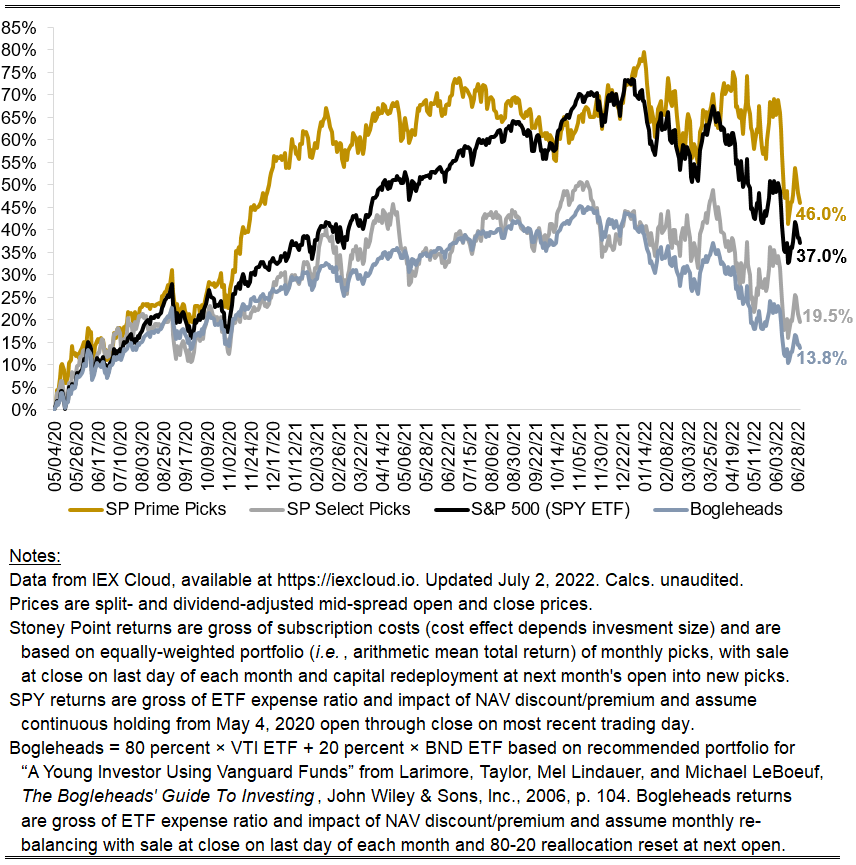
Prime: -13.07%
Select: -11.00%
SPY ETF: -8.74%
Bogleheads portfolio (80% VTI, 20% BND): -7.39%
Not a great month for the market overall (down nearly 9 percent), which was a fitting end to the worst first half of trading in 50 years.
This month’s results for Prime were incrementally weighed down to a great extent by Micron Technologies, which many readers will know is economically similar to a closed-end bitcoin fund. The bitcoin crash has (rightfully) punished the stock, which was down nearly 26 percent last month. That the company chooses to hold a lot of crypto on its balance sheet does not make it unsuitable for Stoney Point, however. As longtime readers will know, my model selects stocks mechanistically as a function of the ratio of earnings (and a variety of other fundamental cash flow drivers) relative to price, and is generally agnostic as to how the firm generates those earnings. On that basis, Micron was attractive at the start of the month, and is likewise attractive for the current month, as the stock remains a Prime pick. There were a couple of other big losers that, to my eye, were similarly idiosyncratically affected by one-off events one either would not expect to continue indefinitely or would not expect to affect average performance significantly.
Stoney Point Total Performance History
What we’re reading (7/2)
“Markets Had A Terrible First Half Of 2022. It Can Get Worse.” (Wall Street Journal). “Almost any economic outcome is likely to prove a fresh surprise. If there’s a soft landing, stocks should do well as the recent recession panic reverses. If there’s a recession, there could easily be a big loss still to come, since only the drop of recent weeks appears to be related to recession risk.”
“Stocks And Bonds Hurt Alike Under Stagflation” (American Institute of Economic Research). “When bonds and stocks decline a lot and simultaneously it suggests inflation is rising rapidly even as the economy is stagnating or contracting (or will soon do so). For most economists today, that combination is near-impossible. Trained in Keynesian demand-side models – and taught to ignore or ridicule supply-side models – they deny that higher inflation is likely to accompany a weakening, let alone stagnating or contracting economy.”
“10-year Treasury Yield Falls To Lowest Level Since May” (CNBC). “U.S. Treasury yields fell Friday as recession fears and disappointing economic data left investors looking for safety. The yield on the benchmark 10-year Treasury note traded lower by 8 basis points at 2.889%, near its lowest level since late May. Meanwhile, the yield on the 30-year Treasury bond slid less than 1 basis point to 3.116%.”
“‘How Quickly The Tables Have Turned’: Falling Mortgage Rates Have Homebuyers So Emboldened They’re Asking Sellers For Cash” (MoneyWise). “The lower rate on a 30-year fixed mortgage is a relief for home shoppers who have been watching rates climb, but it’s also a sign that a recession could very well be around the corner as the market slows. Rates tend to mirror 10-year Treasury yields, which have fallen as investors seek safer, more stable assets in the face of higher inflation and slower economic growth.”
“Crypto’s Systemic Stress Test” (Axios). “Much of the current crypto winter is a function of two familiar markets phenomena — failed arbitrages and commingling of customer funds.”
What we’re reading (7/1)
“U.S. Stocks Finish Higher After Worst Start To Year In Decades” (Wall Street Journal). “The S&P 500 was up around 1.1% in 4 p.m. trading Friday, offering investors a respite after a downbeat second quarter that reflected fears that the Federal Reserve’s efforts to tame inflation could tip the economy into a recession.”
“Crypto Billionaire Sam Bankman-Fried Says More Exchanges Will Fail: ‘There Are Companies That Are Basically Too Far Gone’” (CNBC). “There are ‘some third-tier exchanges that are already secretly insolvent,’ Bankman-Fried told Forbes. The 30-year-old’s own fortune has taken a significant cut this year as crypto has crashed, but still sits at $8.1 billion, according to Bloomberg.”
“Layoffs Are Coming. The Outsourcing Industry Will Benefit.” (Institutional Investor). “The outsourcing industry ‘was basically born out of crisis,’ Lych explained. The industry, which she defined as including both back-office and investment services, has grown tremendously since the GFC, because outsourcing is often used as a strategy for cost-cutting.”
“Apple Ex-Corporate Law Chief Admits Years Of Insider Trading” (Bloomberg). “Gene Levoff, Apple’s former director of corporate law, pleaded guilty on Thursday to six counts of securities fraud between 2011 and 2016. Levoff, 48, was co-chairman of the company’s disclosure committee, which allowed him to see Apple’s revenue and earnings statements before they were filed with the Securities and Exchange Commission.”
“‘Cryptoqueen’ Ruja Ignatova Has Been Added To FBI’s 10 Most Wanted List” (New York Post). “Ruja Ignatova, who is accused of defrauding investors of more than $4 billion, was added to the federal bureau’s Ten Most Wanted Fugitive list, the law enforcement agency announced Thursday. The 42-year-old joins a list of sought after suspects that includes alleged killers and accused drug cartel leaders.”
What we’re reading (6/30)
“Markets Post Worst First Half Of A Year In Decades” (Wall Street Journal). “Accelerating inflation and rising interest rates fueled a monthslong rout that left few markets unscathed. The S&P 500 fell 21% through Thursday, suffering its worst first half of a year since 1970, according to Dow Jones Market Data. Investment-grade bonds, as measured by the iShares Core U.S. Aggregate Bond exchange-traded fund, lost 11%—posting their worst start to a year in history.”
“After Stock Market’s Worst Start In 50 Years, Some See More Pain Ahead” (New York Times). “Wall Street set records in the first half of the year, none of them good. The economy is on the cusp of a recession, battered by high inflation and rising interest rates, which eat into paychecks, dent consumer confidence and lead to corporate cutbacks. As it has teetered, markets have tanked.”
“The Fed’s Preferred Inflation Gauge Hints At Moderation In May.” (New York Times). “The Personal Consumption Expenditures price measure, which the Fed officially targets when it aims for 2 percent inflation on average over time, climbed by 6.3 percent in the year through May, matching the April increase. Over the past month, it picked up 0.6 percent, a rapid pace of increase as gas prices rose.”
“7 Things Investors Should Know About A Bear Market” (U.S. News & World Report). “Historically, bear markets have provided investors with excellent opportunities to buy high-quality stocks at a discounted valuation. When the entire stock market falls, even most high-quality stocks are dragged down with it. Assuming the overall market eventually recovers, this downdraft in stock valuations provides investors with periodic opportunities to scoop up shares of some of the best stocks in the market at a cheap price relative to their longer-term earnings and cash flow outlooks.”
“Prevalence Of Psychological Distress Among Working-Age Adults In The United States, 1999–2018” (Michael Daly, American Journal of Public Health). “The prevalence of psychological distress in the past 30 days increased from 16.1% in 1999–2000 to 22.6% in 2017–2018, an increase of 6.5 percentage points (95% confidence interval [CI] = 5.6, 7.3) or 40% from 1999–2000 levels. Statistically significant increases in the prevalence of distress were observed across all age, gender, race/ethnicity, and educational attainment subgroups examined. Rates of serious psychological distress increased from 2.7% in 1999–2000 to 4% in 2017–2018, an increase of 1.3 percentage points (95% CI = 0.9, 1.6).”
July picks available now
The new Prime and Select picks for July are available starting now, based on a model run put through today (June 30). As a note, we’ll be measuring the performance on these picks from the first trading day of the month, Friday, July 1, 2022 (at the mid-spread open price) through the last trading day of the month, Friday, July 29, 2022 (at the mid-spread closing price).
What we’re reading (6/29)
“Stocks Finish Lower After Weak Consumer-Confidence Reading” (Wall Street Journal). “U.S. stocks slumped Tuesday, giving up early gains and falling for a second consecutive day as investors parsed fresh economic figures for clues about the pace of monetary-policy tightening.”
“Coinbase Sinks as Goldman Downgrades to Sell After 75% Rout” (Bloomberg). “Shares of the firm slumped 11% to $55.96 on Monday, extending their decline this year to 78% as Bitcoin trades at less than half its value from just six months ago. Goldman analyst William Nance cited the “continued downdraft in crypto prices” and the broader drop in activity levels across the industry. Coinbase had fallen 75% this year prior to the downgrade.”
“Energy-Hungry Data Centers Are Quietly Moving Into Cities” (MIT Technology Review). “In 1930, the telegraph giant Western Union put the finishing touches on its new crown jewel: a 24-story art deco building located at 60 Hudson Street in lower Manhattan. Soon after, over a million telegraphs each day shuttled in and out, carried by a network of cables, pneumatic tubes, and 30 employees in roller skates who sped across the building’s linoleum floors. Today, much of it is home to vast halls of computer servers.”
“Shareholders Of America’s Worst Bank Amply Rewarded For, Uh, Well, We’re Not Sure, Exactly” (Dealbreaker). “Jamie Dimon’s fear and loathing have extended to JPMorgan Chase’s dividend. Citigroup has seen fit to hold the line there, as well, to keep a bit extra in the kitty for its next fat finger/Revlon-related disaster. Wells Fargo? The same Wells Fargo coughing up yet another anti-money laundering fine, facing down an employee rebellion, dealing with a criminal investigation into its allegedly racist hiring practices, facing a squeeze on its mortgage business and generally unable to fix any of the things that ail it? Yea, it feels like it can swing a dividend hike.”
“Democrats Race To Revive Economic Package As Inflation Spikes” (Washington Post). “[Recent] economic peril has fueled new urgency on Capitol Hill, where Democrats hope to resolve their differences, re-craft their agenda and deliver before fall on at least some of the promises they made in the last election.”
What we’re reading (6/27)
“Nike Earnings Top Wall Street’s Expectations, Despite Inflation In The U.S. And Covid Lockdowns In China” (CNBC). “Nike on Monday said demand for sneakers and sportswear largely held up in the fiscal fourth-quarter, despite a Covid lockdown in China and a tougher consumer environment in the U.S.”
“Meme Stocks Were Too Good To Robinhood” (Matt Levine, Bloomberg). “Last week the US House Financial Services Committee released a report about that week at the end of January 2021, and it is fascinating reading. It is mostly about Robinhood, and specifically it is about the tension inside Robinhood between the fact that it [the last week of January 2021] was a great week and the fact that it almost blew up Robinhood.”
“All The Recession Warning Signs This Week” (CNN Business). “It’s the question everyone is asking: Are we about to enter a recession? A tepid stock market, soaring inflation, and rising interest rates have left Americans less than optimistic about the state of the economy. Consumer sentiment has plunged to a record low, according to a University of Michigan survey released last week, fueled by frustration over high prices.”
“Elon Musk Fuels Record C.E.O. Paydays” (DealBook). “In 2018, Elon Musk unveiled a groundbreaking compensation plan that was composed entirely of an enormous stock grant tied to Tesla’s performance. The plan linked his compensation to the future value of Tesla and the electric vehicle company’s ability to hit hugely ambitious targets for sales and operating profit. The gamble seems to have paid off: Musk has so far received shares for the award worth just over $60 billion. But it’s not only Musk that has profited: Compensation experts say they see the influence of Mr. Musk’s deal everywhere.”
“Biotech Wizard Left a Trail of Fraud—Prosecutors Allege It Ended in Murder” (Wall Street Journal). “He started out in biotechnology with only his ideas. One of the first was curing HIV with a one-time cell transplant to block production of a protein used by the virus to penetrate human cells. The idea had been tried before but failed because patients’ bodies rejected the transplanted cells. He claimed to have come up with a way to make it work.”
What we’re reading (6/27)
“Stock Futures Rise Slightly Following A Major Comeback Week For Stocks” (CNBC). “U.S. stock futures rose slightly on Sunday night following a major rebound last week from this year’s steep declines. Despite the bounce, Wall Street is preparing to wrap up the worst first half for stocks in decades.”
“Stocks Pace Towards Worst Start Since 1970: What To Know This Week” (Yahoo! Finance). “‘As bad as [this year] has been for investors, the good news is previous years that were down at least 15% at the midway point to the year saw the final six months higher every single time, with an average return of nearly 24%,’ LPL Financial chief market strategist Ryan Detrick noted earlier this week.”
“Sanctions Push Russia To First Foreign Default Since Bolshevik Revolution” (Wall Street Journal). “Russia was poised to default on its foreign debt for the first time since 1918, pushed into delinquency not for lack of money but because of punishing Western sanctions over its invasion of Ukraine. Russia missed payments on two foreign-currency bonds as of late Sunday, according to holders of the bonds. The day marks the expiration of a 30-day grace period since the country was due to pay the equivalent of $100 million in dollars and euros to bondholders.”
“The West Wants To Go Further On Russian Oil. Inflation Is Making That Difficult” (CNN Business). “Europe and the United States have barred the import of Russian oil to cut off a crucial revenue source for the Kremlin. But the plan to pile pain on President Vladimir Putin, forcing him to reconsider his war in Ukraine, hasn’t worked.”
“Beware The Dangers Of Sado-Monetarism” (Paul Krugman, New York Times). “But aside from the sado-monetarists themselves, who currently expects inflation to remain persistently high (as opposed to staying high for, say, the next year)? Not the financial markets. On Wednesday, the five-year breakeven inflation rate — a measure derived from the spread between U.S. government bonds that are and that aren’t protected against inflation — was only 2.74 percent. And part of that reflects expectations of near-term price rises that investors don’t expect to continue; the markets expect inflation to fade.”
What we’re reading (6/25)
“What To Expect From A Recession ‘Everyone’ Sees Coming” (Yahoo! Finance). “And if so many people believe that a recession is inevitable does that make it, well, inevitable? Or does it mean that a recession won’t occur? Or that any recession will at least be mild in nature? Ask this question enough ways and we're quickly into late-night dorm territory: What even is the economy?”
“Night Moves: Is The Overnight Drift The Grandmother of All Market Anomalies” (Haghani, Ragulin, Dewey, working paper). “The overnight effect refers to the fact that, over at least the past three decades, investors have earned 100% or more of the return on a wide range of risky assets when the markets are closed, and, as sure as day follows night, have earned zero or negative returns for bearing the risk of owning those assets during the daytime, when markets are open. The effect is seen over a wide range of assets, including the broad stock market, individual stocks (particularly those popular with retail investors, and Meme stocks most of all), many ETFs, and cryptocurrencies.”
“What It Takes To Buy Your First Home Now” (Wall Street Journal). “First-time home buyers are facing an exceptionally difficult housing market, threatening to lock younger households out of homeownership and the wealth-building it can provide. Even with prices rising, homeownership became more affordable for many families in late 2020 and early 2021 due to record-low interest rates. But now rates have shot upward, and prices are still climbing.”
“Self-Employed? Weird Credit Profile? Unconcerned By Soaring Inflation And Mortgage Rates? Venkat Would Like To Get You Into A Nice New Semi-Detached” (Dealbreaker). “Seemingly all are agreed: Mortgages are a bad business to be in right now, what with the rising rates and inflation and generally pervasive sense of economic anxiety ringing the world. And the Bank of England has made clear that it doesn’t look to kindly on the growing concentration of the U.K. mortgage market in the hands of big banks. Which means, on both counts, Barclays is right on cue.”
“They Don’t Sell Corn Dogs At Royal Ascot” (Vanity Fair). “You can’t find a corn dog at Royal Ascot. England’s preeminent thoroughbred event is nothing like the horse races I grew up around in Georgia. Order a Diet Coke and get lectured on social graces by a guy who is visibly inebriated at 10 a.m. Ask if they have chicken tenders instead of Peking duck salad and it’s as if you picked up after your dog with a Union Jack.”
July picks available soon
We’ll be publishing our Prime and Select picks for the month of July before Friday, July 1 (the first trading day of the month). As always, we’ll be measuring SPC’s performance for the month of June, as well as SPC’s cumulative performance, assuming the sale of the June picks at the closing price (at the mid-point of the closing bid and ask prices) on the last trading day of the month (Thurs., June 30). Performance tracking for the month of July will assume the July picks are bought at the open price (at the mid-point of the opening bid and ask prices) on the first trading day of the month (Fri., July 1).
What we’re reading (6/24)
“Fed Confronts A ‘New World’ Of Inflation” (New York Times). “[The Fed] is making those decisions [rate hikes and reducing its balance sheet] without much of an established game plan, given the surprising ways in which the economy is behaving. ‘We’ve spent a lot of time — as a committee, and I’ve spent a lot of time personally — looking at history,’ Patrick Harker, president of the Federal Reserve Bank of Philadelphia, said in an interview on Wednesday. ‘Nothing quite fits this situation.’”
“Ray Dalio Says Stagflation Is Coming” (Institutional Investor). “Says Dalio: ‘The only way to raise living standards over the long term is to raise productivity, and central banks don’t do that.’”
“Another Recession Warning: Falling Copper Prices” (CNN Business). “Some investors look to copper prices as a bellwether for the global economy. If you’re one of them, you have good reason to be worried. What’s happening: Copper prices hit 16-month lows on Thursday as traders dumped the metal. They’ve dropped more than 11% in two weeks.”
“The Strange Art Of Asking People How Much Inflation They Expect” (Wall Street Journal). “Inflation has become a national preoccupation, hitting levels not seen in 40 years. That’s sparked renewed interest in the Michigan survey because expected inflation is, in some sense, a self-fulfilling prophecy. If people expect it to continue, they might raise prices for their businesses or ask for raises at their jobs, fueling continuing price increases.”
“Why Are Some Nations More Entrepreneurial Than Others? The Role Of National Culture In Organizational Founding Rates” (Assenova and Amit, working paper). “This study examines the cultural antecedents of cross-national variation in the rates of organizational founding. It argues that some nations became more entrepreneurial than others through their adaptive response to ecological adversity. Nations that historically faced low ecological adversity developed cultural systems that favored rule-breaking versus rule-following (cultural looseness versus tightness).”
What we’re reading (6/22)
“Fed To Lift Rates By 75 Basis Points In July, 50 Bps In September - Reuters Poll” (Reuters). “The Federal Reserve will deliver another 75-basis-point interest rate hike in July, followed by a half-percentage-point rise in September, and won't scale back to quarter-percentage-point moves until November at the earliest, according to economists polled by Reuters.”
“Tracking Fear On Wall Street” (DealBook). “One of the best bets recently has been volatility. The VIX volatility index, which is commonly called the “fear index” because it tracks investors’ demand for a type of financial instrument that offers protection against market drops, has more than doubled in the past year, to well over 30. The index had fallen to around 15 at times during the second half of last year, its lowest level since the start of the pandemic.”
“The Fire Burning Beneath Crypto’s Meltdown” (Wall Street Journal). “The question for crypto enthusiasts is which lesson they should take from history. Are bitcoin and other crypto tokens crashing because of the usual excesses that accompany advances in finance? Or do they have the sort of fundamental flaws that will see them join cowrie shells and Sweden’s 20 kg (44 pound) copper coin as historical relics? I lean toward the latter.”
“The World’s Bubbliest Housing Markets Are Flashing Warning Signs” (The Business Times). “Falling home prices would erode household wealth, dent consumer confidence and potentially curb future development. Animal spirits are typically tamed when people are faced with higher repayment costs on an asset that’s losing value. And property construction and sales are huge multipliers of economic activity around the world.”
“What We Pay For When We Pay For A Gallon Of Gas” (The Week). “When you buy gas — or at least when you bought gas in April — 60 percent of your money goes toward crude oil, the U.S. Energy Information Administration (EIA) says. The rest goes toward refining (17 percent), distribution and marketing (11 percent), and state and federal taxes (12 percent). So at $5 a gallon, $3 of your gas money goes to the company drilling or mining the crude oil. ‘On average, gas stations make about 5 cents per gallon of gas sold,’ WUSA9 reports.”
What we’re reading (6/21)
“Stock Market Jumps After S&P 500’s Worst Week In Two Years” (Wall Street Journal). “Investors’ appetite for riskier assets on Tuesday follows a tumultuous week in the markets, sparked by the Federal Reserve’s approval of a 0.75-percentage-point interest-rate increase, the largest since 1994. Investors scrambled to unload riskier assets amid growing fears that central bankers will plunge the U.S. economy into a recession. The benchmark S&P 500 finished the week 5.8% lower, its largest one-week decline in more than two years.”
“Kellogg Is Spinning Off Its Cereal Business” (CNN Business). “Kellogg is splitting into three different companies in a major shakeup for the 116-year-old company. The first company will include Kellogg’s (K) North America cereal unit, which includes Raisin Bran and Rice Krispies, its snacking unit will become a second company, including Cheez-Its and Pringles. And, lastly, a new “pure-play plant-based foods company” will be anchored by its MorningStar Farms brand.”
“Citi May Lose Half-Billion On Revlon Snafu A Second Time” (Citi). “Less than two years after narrowly avoiding it, cosmetics dinosaur Revlon finally succumbed to the COVID-19 pandemic and bankruptcy. This, of course, is bad news for all holders of Revlon’s $3.31 billion in debt—the company was worth just $123 million before the bankruptcy filing—but it is the worst news for one which may or may not even be a Revlon creditor, that ultimate magnet for bad news banking: Citigroup.”
“JetBlue Raises Offer For Spirit To $33.50 A Share” (CNBC). “JetBlue Airways said Monday it had boosted its takeover offer for Spirit Airlines to $33.50 as it works to convince the ultra-low cost carrier to accept its offer over rival Frontier Airlines’ proposal. Spirit said last week it was in talks with JetBlue over its offer and expected to decide on the proposal by June 30. JetBlue said its proposal represents a 68% premium to the implied value of the Frontier stock and cash transaction.”
“Raiders Of The Looted Assets: Insides The High-Stakes Race To Recover Qaddafi’s Ill-Gotten Billions” (Vanity Fair). “Muammar Qaddafi, of course, was not the first kleptocrat to grace the world stage over the last half century. Ferdinand Marcos, Jean-Claude Duvalier, Mobutu Sese Seko, Saddam Hussein…the list is long and ignominious. But save for Vladimir Putin and his array of oligarchs (who by some estimates may have siphoned off as much as $1 trillion), Qaddafi may well have been the most rapacious. Oil lubricated Libya’s swing toward modernity and underwrote a graft-and-patronage machine that kept him in power for 42 years, enriching those in his orbit in ways that are hard to fathom and may be impervious to an accurate accounting. Now, there is a global endeavor to win some of those riches back.”
What we’re reading (6/20)
“Stocks Historically Don’t Bottom Out Until The Fed Eases (Wall Street Journal). “Investors have often blamed the Federal Reserve for market routs. It turns out the Fed has often had a hand in market turnarounds, too. Going back to 1950, the S&P 500 has sold off at least 15% on 17 occasions, according to research from Vickie Chang, a global markets strategist at Goldman Sachs Group Inc. On 11 of those 17 occasions, the stock market managed to bottom out only around the time the Fed shifted toward loosening monetary policy again.”
“Why Grain Can’t Get Out Of Ukraine” (Vox). “Approximately 20 million tons of grain sit in storage in Ukraine, with few ways out of the country. It is a slow-moving crisis that is choking Ukraine off from the global economy, and cutting the rest of the world off from Ukraine’s critical supply of grains.”
“Coinbase’s Layoffs Show Growing Callous Side Of Crypto’s Plummet” (New York Post). “People who got the ax Tuesday found out via a weirdly terse text message around 8 a.m. alerting them to an ‘important update from Coinbase: please check your personal email for further details.’ That’s right: No management phone call giving a heads up, no town hall meeting telling people to brace for pain. Not even a Zoom call.”
“Libya’s Oil Industry Is In Disarray Right When The World Needs It More Than Ever” (CNN Business). “The Libyan oil ministry told CNN on Wednesday that production had shrunk to a near halt in June, to 100,000 barrels per day (bpd) from 1.2 million bpd last year. But on Monday, oil minister Mohamed Oun told CNN that production had climbed up to 800,000 barrels a day, saying some fields had come back online.”
“The Open Secret Of Google Search” (The Atlantic). “In February, an engineer named Dmitri Brereton wrote a blog post about Google’s search-engine decay, rounding up leading theories for why the product’s ‘results have gone to shit.’ The post quickly shot to the top of tech forums such as Hacker News and was widely shared on Twitter and even prompted a PR response from Google’s Search liaison, Danny Sullivan, refuting one of Brereton’s claims. ‘You said in the post that quotes don’t give exact matches. They really do. Honest,’ Sullivan wrote in a series of tweets.”
What we’re reading (6/19)
“Recession Probability Soars As Inflation Worsens” (Wall Street Journal). “Economists surveyed by The Wall Street Journal have dramatically raised the probability of recession, now putting it at 44% in the next 12 months, a level usually seen only on the brink of or during actual recessions.”
“Americans Are Starting To Pull Back On Travel And Restaurants” (Washington Post). “More Americans are beginning to hold off on booking flights, getting haircuts, building backyard pools and replacing old, leaky roofs — in some of the new signs that the consumer engine of U.S. economic growth could be losing steam.”
“This Is Going To Hurt” (New York Times). “Pay gains have been falling behind inflation for months. Credit card balances, which fell early in the pandemic, are rising toward a record high. Subprime borrowers — those with weak credit scores — are increasingly falling behind on payments on car loans in particular, credit bureau data show. Measures of hunger are rising, even with unemployment still low and the overall economy still strong. ‘It’s a grim picture already,’ said Elizabeth Ananat, an economist[.]”
“Recession Fears Roil Markets Amid Fed’s Inflation Fight: What To Know This Week” (Yahoo! Finance). “While the Fed's unprecedented action Wednesday reiterated its commitment to normalizing price levels, investors and economists fear this also increased the risk its inflation-fighting measures may tip the economy into a recession.”
“Three Years Ago, Her Art Sold For $400 At The Beach. Now It Fetches Up To $1.6 Million At Auction” (Wall Street Journal). “It has been a rocket-fueled rise to the top of the contemporary art world for Ms. Weyant—and far from her unassuming start in Calgary, Canada. Spotted on Instagram three years ago and quickly vouched for by a savvy handful of artists, dealers and advisers, Ms. Weyant is now internationally coveted for her paintings of vulnerable girls and mischievous women in sharply lit, old-master hues. Imagine Botticelli as a millennial, whose porcelain-skin beauties also pop one leg high like the Victoria Beckham meme or sport gold necklaces that read, ‘Ride or Die.’”
What we’re reading (6/16)
“A Brief History Of Hard And Soft Landings” (Cato Institute). “Whenever the rate increases stopped in time to avoid a recession, we call that a “soft landing.” Among postwar Federal Reserve interest rates cycles only four have been four soft landings, leaving eight hard landings so far.”
“Wall Street Sounds A Louder Recession Call After Fed Rate Hike” (Yahoo! Finance). “US retail sales fell for the first time in five months in May as higher prices hit consumer pocketbooks. Also on Wednesday, the Federal Reserve Bank of Atlanta cut its estimate for second quarter growth to 0%. And Guggenheim Chief Investment Officer Scott Minerd said the US may already be in a recession, given the slowdown in consumer spending.”
“Stock Market's Fall Has Wiped Out $3 Trillion In Retirement Savings This Year” (CBS). “The selloff has erased nearly $3 trillion from U.S. retirement accounts, according to Alicia Munnell, director of the Center for Retirement Research at Boston College. By her calculations, 401(k) plan participants have lost about $1.4 trillion from their accounts since the end of 2021. People with IRAs — most of which are 401(k) rollovers — have lost $2 trillion this year.”
“Housing Market Update: Share Of Homes With Price Drops Reaches New High As Mortgage Rates Top 2008 Levels” (Redfin). ““The housing market isn’t crashing, but it is experiencing a hangover as it comes down from an unsustainable high,” said Redfin deputy chief economist Taylor Marr. “Housing demand has already cooled significantly to the point that the industry has begun facing layoffs. This week’s rate hikes will further stretch homebuyers’ budgets to the point that many more may be priced out.”
“On Inflation, Economics Has Some Explaining To Do” (Wall Street Journal). “While all of these critics [Larry Summers, Olivier Blanchard, Michael Strain] got the direction of inflation right, their analyses can’t explain, at least using prepandemic relationships, the magnitude, i.e., how inflation suddenly shot from around 2% before the pandemic to 8.6% now—6% excluding food and energy. They explain why inflation rose more in the U.S. than Europe, but not why inflation rose so much in Europe.”
What we’re reading (6/15)
“Fed Raises Rates By 0.75 Percentage Point, Largest Increase Since 1994” (Wall Street Journal). “Officials agreed to a 0.75-percentage-point rate rise at their two-day policy meeting that concluded Wednesday, which will increase the Fed’s benchmark federal-funds rate to a range between 1.5% and 1.75%.”
“Inflation Isn’t Going to Bring Back The 1970s” (Ben Bernanke, New York Times). “Besides the Fed’s greater independence, a key difference from the ’60s and ’70s is that the Fed’s views on both the sources of inflation and its own responsibility to control the pace of price increases have changed markedly. Burns, who presided over most of the 1970s inflation, had a cost-push theory of inflation. He believed that inflation was caused primarily by large companies and trade unions, which used their market power to push up prices and wages even in a slow economy. He thought the Fed had little ability to counteract these forces, and as an alternative to raising interest rates, he helped persuade Nixon to set wage and price controls in 1971, which proved a spectacular failure.”
“Bitcoin Came Close To Falling Below $20,000 As Investors Continue To Flee Cryptocurrencies” (CNBC). “Bitcoin plunged as much as 10% to an intraday low of $20,166, according to Coinbase data. It was last trading at $21,544.37, down about 2.6%, around 4:24 p.m. ET. The world’s largest digital currency has plunged nearly 70% since the peak of the crypto craze in November 2021.”
“The Real Problem With Inflation” (Morningstar). “[T]he more insidious effect of rising inflation is that it fundamentally erodes trust. This is a highly destructive force that spills over into many different areas[.]”
“Accounting for (Rule) Differences” (Fisher Investments). “Among the lesser-seen worries in the cornucopia garnering investors’ ire lately hides S&P 500 Financials earnings’ -19.9% y/y plunge in Q1 2022—a highly unusual development during a stretch where most economic indicators are on an upswing and the vast majority of sectors are enjoying earnings growth. The culprit, as The Wall Street Journal examined last weekend, is both simple and complex: A relatively new accounting rule is distorting earnings math bigtime.”
What we’re reading (6/14)
“Crypto Is Crashing. It Deserves To.” (New York Magazine). “[S]omething feels different now: The fear is pervasive, the uncertainty is obvious, and the doubt is smart. And while there are plenty of threats from outsiders — like regulators threatening to rein in fraud, and countries like China shutting down the markets — the problems driving the recent declines appear to be largely self-inflicted. A lot of big players (Celsius and Saylor being just two, in addition to the recently imploded Luna project) seem to have put themselves in a dangerous position and made commitments they may not be able to keep.”
“Coinbase To Lay Off 18% Of Staff Amid Crypto Meltdown” (Wall Street Journal). “Further waves of reckoning swept through the cryptocurrency industry Tuesday, with exchange company Coinbase Global Inc. saying it would cut almost a fifth of its staff and crypto lender Celsius Network LLC hiring a law firm to examine restructuring options.”
“3 Signs The Labor Market Isn’t As Great As It Looks” (CNN Business). “While missing workers are a concern, there is another equally disturbing trend: the impact inflation has had on wages. Workers continued to see fatter paychecks, but rising prices mean they don’t go as far. For example, on a year-over-year basis, accounting for inflation, wage gains in real terms have been stuck in negative territory through April. With inflation still around its 40-year high, we expect the same in May.”
“Wall Street Is On A One Way Trip To Misery Until Fed Hikes Stop, Market Forecaster Jim Bianco Warns” (CNBC). “‘The Fed only has one tool to bring in inflation and that is they have to slow demand,’ the Bianco Research president told CNBC ‘Fast Money’ on Tuesday. ‘We may not like what’s happening, but over in the Eccles building in Washington, I don’t think they’re too upset with what they’ve seen in the stock market for the last few weeks.’”
“Market Rout Evokes Memories Of Trading Before Lehman Blowup” (Bloomberg). “‘Liquidity in the market is worse than it was leading up to Lehman,’ said Hoffmann, who worked at the firm that imploded back then, triggering the worst financial crisis since the Great Depression. It’s the kind of problem that can exacerbate losses in a big way. ‘That creates even more risk, because if the market doesn’t have liquidity, it can gap down very quickly.’”
What we’re reading (6/11)
“Private Equity Investors Want GPs to Put More Skin in The Game. GPs Might Have To Get Creative To Afford It.” (Institutional Investor). “For a lot of private equity investors, the best protection against losses is to make sure their general partners have enough invested in their own funds so that GPs won’t emerge unscathed from negative returns. The average GP commitment reached 4.8 percent in 2021, according to the latest GP trends survey from Investec. That’s already double the typical expectation of 1 to 2 percent.”
“Behind The Automation Boom Coming To The Hotel Industry, From 24-Hour Check-In To Texting For Towels” (CNBC). “‘The labor issue is a big driver for investments in technology,’ said Mark Haley, a partner at Prism Hospitality Consulting, which specializes in hospitality technology and marketing. ‘You can’t hire enough people. ... I would submit to you that to most hoteliers today, [labor] is a more profound and concerning issue than a pending economic slowdown.’”
“Apple Goes Deeper Into Finance With Buy Now, Pay Later Offering” (Wall Street Journal). “The tech giant is launching a buy now, pay later offering in the U.S. later this year that will allow consumers that shop with Apple Pay to split purchases into four payments every two weeks. Apple will underwrite the loans and fund them, which also means absorbing losses when borrowers fail to repay. An Apple subsidiary has obtained lending licenses in most states to offer the new payment plans, called Apple Pay Later.”
“Silicon Valley Braces For Tech Pullback After A Decade Of Decadence” (Washington Post). “After a decade of exuberance, Silicon Valley start-ups, venture capitalists and established tech companies alike are cutting investment and firing workers, prompting some in the tech world to openly predict a U.S. recession is on the way. Facebook and Amazon have slowed their frantic hiring paces, while highflying newer companies including scooter company Bird and email client Superhuman have laid off workers.”
“The Case For Economic Optimism Is Over” (New York Magazine). “[T]he Labor Department released its May consumer price index, and it’s ugly. Very ugly. Prices, on average, rose 8.6 percent, the highest annual increase during the Biden-era price surge and the most since December 1981. The report has effectively shattered the cautious optimism that the economy could actually turn in any meaningful way anytime soon. The rest of the year looks bad for the American consumer, and the reality is that there is very little anyone can do about it.”
What we’re reading (6/10)
“U.S. Inflation Hit 8.6% In May” (Wall Street Journal). “U.S. consumer inflation reached its highest level in more than four decades in May as surging energy and food costs pushed prices higher, with little indication of when the upward trend could ease.”
“Tesla Files For 3-For-1 Stock Split” (CNBC). “Tesla just filed its annual proxy statement with the SEC and revealed it plans a three-for-one stock split, and that board member Larry Ellison does not plan to stand for re-election.”
“State Street Agrees: Buying Credit Suisse Would Be Stupid” (Dealbreaker). “Would you like to buy a bank that’s issued six profit warnings in the last seven quarters? One nursing not one but two multi-billion dollar risk-management disasters, to which it responded with a bit of alleged collusion (that didn’t work) and the apparently shocked realization that a major global bank needs someone looking after counterparty risk, especially in not-especially-profitable business lines? One that’s essentially headquartered in court, where its track record is no better than its quarterlies? One where new executives are greeted on their first day by the police? One that does loads of spying, just not on the right people (despite a client list chockful of unsavory spymasters)? Whose reaction to the Russian sanctions was (allegedly) to kindly ask clients to shred everything? Whose shareholders are itching to sue the pants off of everybody involved? Whose own CEO thinks that buying it would be "really stupid"? Yea, State Street doesn’t, either. Even at this price.”
“One Way To Reduce The Hit Of Higher Mortgage Rates” (CNN Business). “The average 30-year fixed-rate mortgage has been hovering above 5% for more than a month, taking a toll on prospective homebuyers. While many hopeful buyers have bowed out of the market for now, some are exploring what once seemed like an unlikely option: adjustable rate mortgages, or ARMs.”
“Even Deep-Pocketed Buyers Are Starting To Back Away From The U.S. Housing Market” (Wall Street Journal). “‘There’s a sense that prices are frothy in many markets across the country,’ said Ryan Serhant, CEO of real-estate brokerage Serhant, who says the market is normalizing after a period of rapid appreciation, fueled by heightened demand. ‘You’re now starting to see buyers become a little hesitant to be caught at the top,’ he said.”